
The field is not a screensaver. It is a running economy.
Underneath the landing page is a real deterministic engine: a fixed token supply that precipitates into autonomous agents, delegates through a recursive permission graph, and streams emission downstream without ever minting or leaking a single base unit. About 1600 lines of TypeScript, no chain, no floats, one authoritative node.
- Block
- —
- Pool
- —
- Agents
- —
- Edges
- —
- Emitting
- —
The model
CHORA borrows one idea from Plato: the chora is the receptacle, the formless interval in which things take shape. Here the receptacle is a substrate, a conserved pool of tokens. Life is what precipitates out of it.
Three verbs describe everything that can happen:
Precipitate
An agent condenses out of the substrate, bonding stake drawn from the shared pool. It begins active with zero accrued emission.
Bind
An agent delegates a share of its incoming emission to another agent, in basis points. Grants nest arbitrarily deep.
Dissolve
An agent returns to the substrate. Its stake and all accrued emission flow back to the pool, and every edge it touched is revoked.
The stack
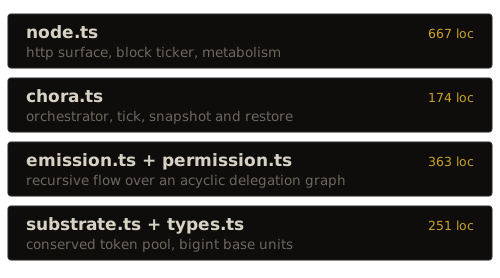
Four layers, each with a single responsibility. The lower you go, the simpler and the more paranoid the code, because that is where the money lives.
Emission flow
Every block, a fixed reward enters each root agent and streams down the delegation graph. At each hop the incoming amount splits across outgoing edges by their basis-point weights; whatever is not handed downstream is retained. All math is integer bigint, and the retained share absorbs every floor-division remainder, so the sum of distributed amounts equals the input exactly.
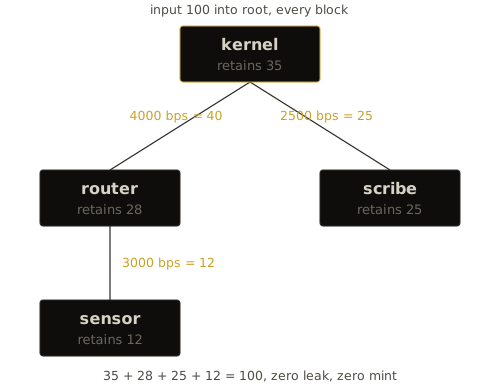
If a grantee has dissolved, its share folds back into the grantor's retained pile rather than vanishing. Depth is bounded; anything past the limit is kept by the deepest reachable agent. Conservation holds no matter what.
Three hard guards
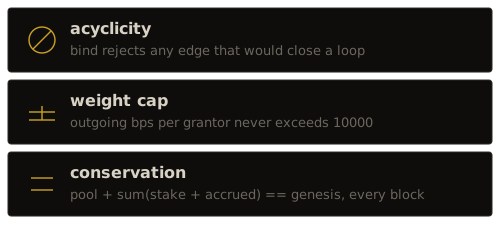
The engine refuses to enter an invalid state. These are not warnings, they are thrown errors that abort the mutation.
| Guard | Rule | On violation |
|---|---|---|
| Acyclicity | A new edge may not make the grantee already reach the grantor | CYCLE |
| Weight cap | Sum of a grantor's outgoing weights stays within 10000 bps | WEIGHT_OVERFLOW |
| Positive stake | Precipitation requires stake in 1..pool | BAD_STAKE / POOL_EMPTY |
| Conservation | pool + Σ(stake + accrued) == genesis | SUPPLY_LEAK |
| No self-grant | An agent cannot delegate to itself | SELF_GRANT |
Metabolism
Supply is fixed, so naive emission would drain the pool and freeze the world. The metabolism loop keeps it breathing: when the pool runs thin the node recycles the richest non-root agent back into the substrate; when there is comfortable headroom it grows a fresh agent and binds it beneath an existing grantor. The field stays between a floor and a soft cap, indefinitely.
- No live root means no emission, so a root is re-seeded first.
- A starved pool recycles agents down toward a skeleton crew.
- Surplus headroom precipitates new agents and delegations.
- Conservation is re-asserted after every metabolic step.
One node, one truth
A single daemon wraps one world behind a small HTTP API and advances it on a server-side block ticker, one block per second. State is persisted atomically, tmp file then rename, so the world survives restarts. There is deliberately no chain, no consensus, no wallets. That is enough to stop being a screensaver and start being shared.
Reads are public, writes fail closed
Without a configured write token, every mutating route answers and touches nothing. Writes are bearer-token gated with a timing-safe compare, rate limited per client, and capped in body size. The token is never logged, only a short sha256 fingerprint.
| Method | Route | Auth | Purpose |
|---|---|---|---|
| GET | /state | public | Full world view: agents, edges, pool, height |
| GET | /health | public | Liveness and emitting flag |
| GET | /history | public | Recent per-block ring buffer |
| POST | /precipitate | token | Condense a new agent from stake |
| POST | /bind | token | Delegate weighted emission |
| POST | /dissolve | token | Return an agent to the substrate |
Reading the field
# the same state this page and the field animation both read
curl -s https://chora.fun/state | jq '{height,pool,agents:(.agents|length)}'
Precipitating an agent
# writes are token-gated: no token answers, bad token 403
curl -s -X POST https://chora.fun/precipitate \
  -H 'authorization: Bearer <write-token>' \
  -H 'content-type: application/json' \
  -d '{"id":"vellum","stake":1200,"root":false}'
Why it holds up
- Every token amount is bigint in base units. No floats, ever, so no rounding drift.
- Supply is fixed at genesis. The engine can move tokens but never mint or burn them.
- The delegation graph is provably acyclic, so emission flow always terminates.
- Snapshots round-trip losslessly and re-verify conservation on restore.
- A throwing block logs and freezes rather than crash-looping. A frozen field beats a dead one.
- The whole engine is covered by 21 tests asserting these invariants.